
Why Grain Size Alone Cannot Define a 3D-Printed Sand Mold: Shape, Packing and Binder Interactions
Published:
2025-01-08
This review connects grain-size distribution, shape, packing, flowability and chemical compatibility to printed-mold strength, gas evacuation, dimensions and casting surfaces, and examines what conventional sand tests need to add for layer-based manufacturing.
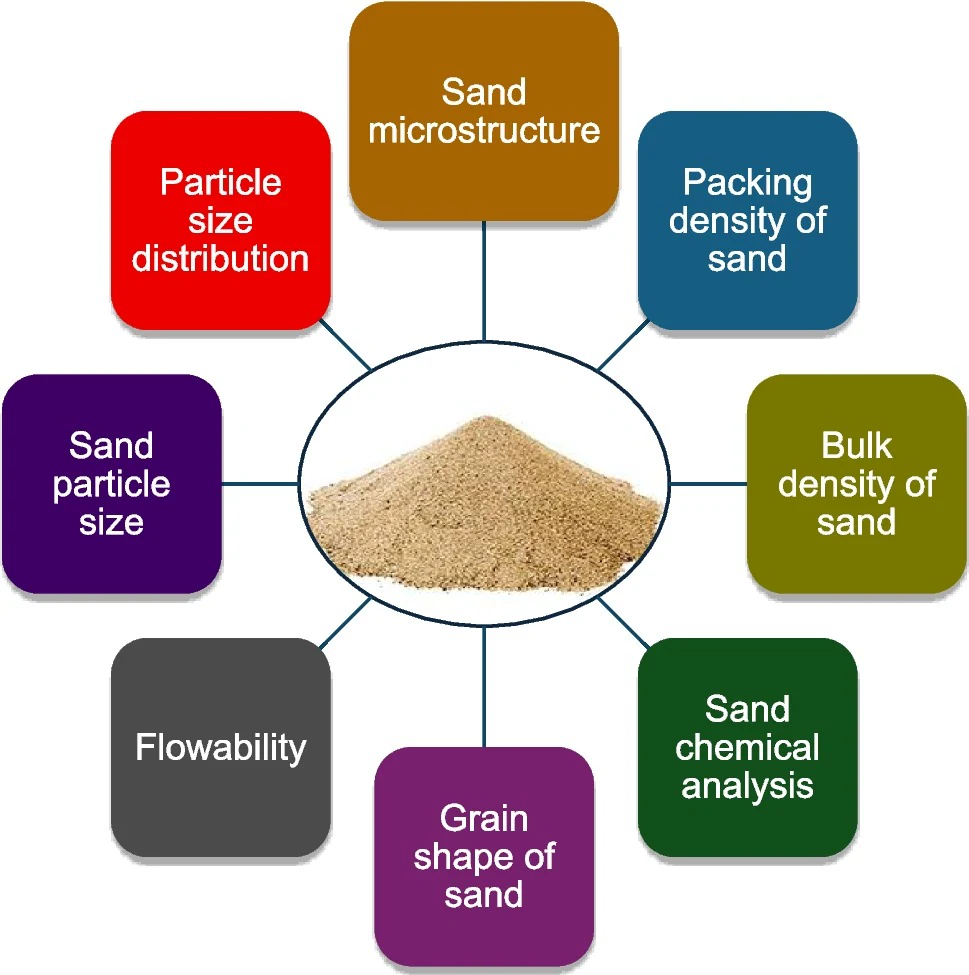
Figure 2 of the original paper: Raw sand properties that affect rapid sand casting: density, particle size, morphology, fluidity and chemical composition, etc.
Sand Properties within the Direct-Tooling Process
Rapid sand casting transfers CAD geometry directly to the modeling equipment, eliminating some traditional pattern making links. However, the equipment can move accurately, which does not mean that every layer of sand entering the mold cavity has the same state. Whether the sand particles can be spread smoothly, how many gaps are left between the particles, and what kind of connections are formed after the binder is sprayed in, will continue to affect the sand mold and sand core. Therefore, the paper shifts the research focus from the printer itself to the raw sand and its combination with the bonding system to discuss why surface roughness, pores and performance inconsistencies still occur after geometric shaping.
This is a critical review, and the evidence comes from existing research, not a unified set of controlled experiments completed by the author using the same equipment and the same alloy. The density, particle size, angle of repose and pore data interspersed in the article correspond to different materials and test conditions. They are suitable to help understand the interaction between parameters without constituting a set of fixed recipes that can be applied directly to any casting. Readers first need to distinguish the basic properties of raw sand, the state after making sand molds, and the evaluation results of the final metal casting.
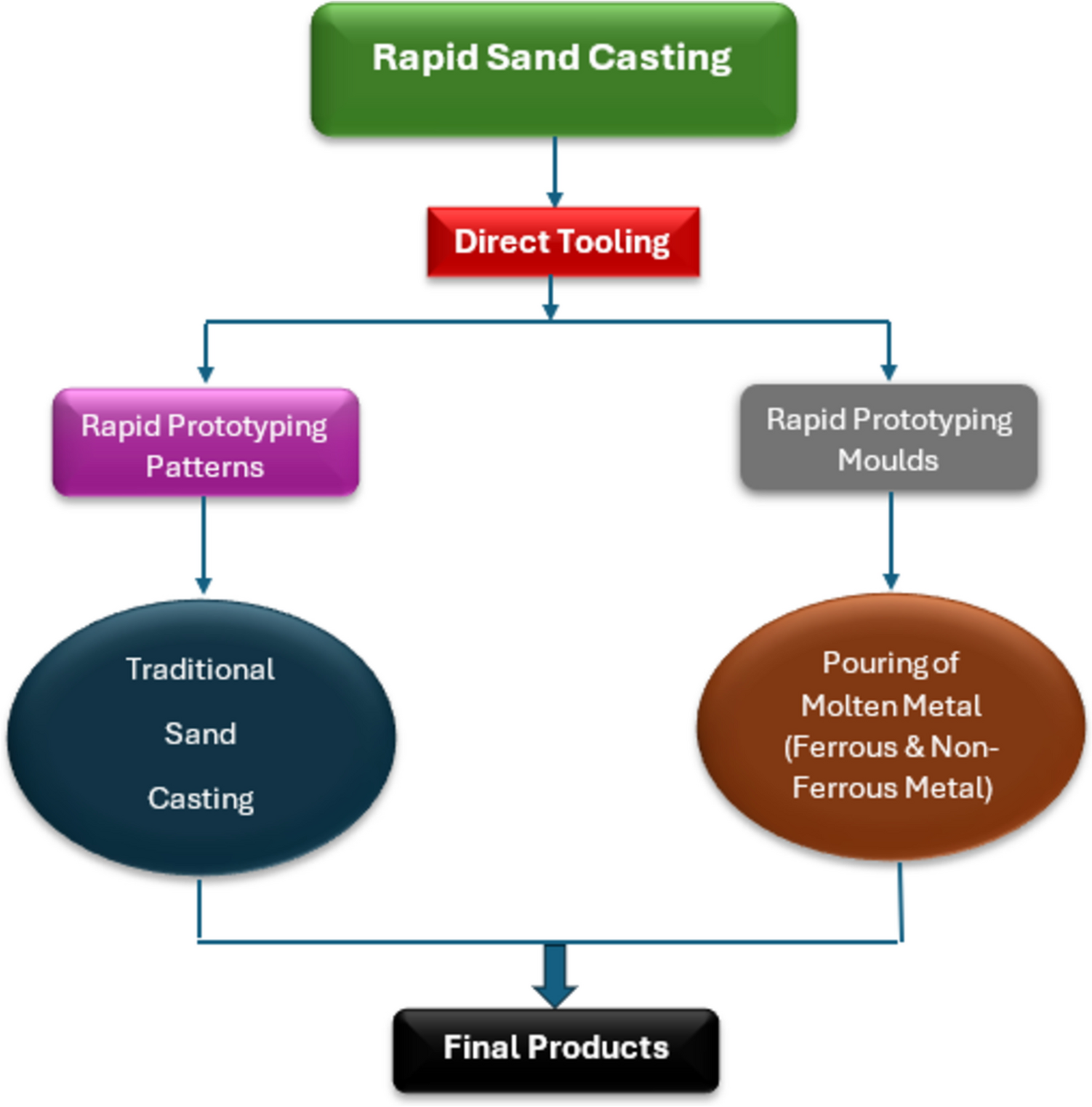
Figure 1 shows direct prototyping and related rapid manufacturing routes. Direct prototyping uses digital geometry to generate sand molds or sand cores, which then still need to be assembled, poured and cleaned; indirect prototyping may first create an intermediate pattern and then transform it through other processes. Reducing pattern preparation can shorten the development chain, but the quality of the finished product is still controlled by the molding materials and casting process. The "fast" discussed in the paper does not mean that all subsequent inspections and process preparations are cancelled.
The raw sand properties summarized by the author include bulk density, microstructure, particle size and distribution, particle shape, surface state, fluidity and chemical composition. They are not independent of each other: particle size and roundness change the stacking pattern, stacking changes the interparticle space and binder distribution, and the chemical composition affects the curing reaction and heating behavior. The same average particle size can correspond to different fine powder ratios and particle morphologies, so a single screening number is not enough to explain all the results.
Bulk density first reflects how much sand is actually put into a certain volume. Grain shape, particle size distribution, moisture content, and compaction methods all change it. The review lists examples of chromite sands of about 2600 kg/m³, and discusses the literature ranges of 1600–1800 kg/m³ and dry sand of about 1.4–1.8 g/cm³ under common molding conditions. These numbers come from different contexts, and high-density mineral sand and ordinary silica sand cannot be put on the same numerical target to judge whether they are good or bad.
In this article, the density relationship is expressed by dividing the sand mass by the occupied volume. For practical purposes, it must be stated clearly whether the volume includes interparticle voids: the packing density includes these voids, while the density of the particles themselves and the dimensionless solid phase volume fraction are other quantities. The focus of the review is the impact of packing on the shape. Just because multiple chapters use words such as packing or bulk, the values obtained by different testing methods cannot be directly regarded as the same indicator.
The effect of particle size is directed both to the surface and to the interior. Fine sand is usually easier to form a flatter cavity surface and helps to reproduce details, but the channels between particles will change and the exhaust may be limited; coarser particles may retain larger gas channels, but make the surface texture more obvious. In the end, it is also necessary to consider whether the binder can cover the particles sufficiently and whether the shape can withstand transportation, assembly and pouring erosion. Therefore, "the finer, the better" or "the coarser, the more breathable" cannot be regarded as a complete conclusion for sand selection.
In addition to the average size, the particle size distribution determines how well the smaller particles fill in between the larger particles. Mixing different particle sizes may improve packing and structural stability, but may also alter pore channels. The screening, compaction and aeration tests reviewed in this review were designed to relate these changes to the strength of the sand mold. A broadly distributed blended sand may require different layup and binder conditions than a uniformly sized sand, even if the average particle size is similar.
When discussing the comparison of a set of particle sizes with air permeability and compressive strength, the original article pointed out that larger particles correspond to higher air permeability, while the 60-mesh sand achieves lower air permeability and has better compressive performance. This is a result from specific literature and is not a recommendation for 60 mesh sand for all printing equipment. Its significance is to show the trade-off between exhaust and mold load-bearing. The alloy temperature, core thickness, binder gas generation and pouring speed need to be taken into consideration in the subsequent judgment.
Particle shape adds another dimension. Angular particles may improve structural stability by fitting into each other, but their flow and contact conditions are different from round particles; round particles are easier to move and rearrange, and may also achieve the required combination with a lower amount of binder. The paper discusses the angular, sub-angular and rounded morphology separately, and recommends using SEM and other methods to observe the actual particles, rather than infer that all batches have the same shape based on the name of the sand type.
The proportion of uncompacted voids quoted in the review is approximately 38%–45% for sub-angular particles, approximately 35%–38% for sub-round particles, and approximately 32%–33% for very round particles. These ranges illustrate that morphology can significantly change the loose packing state, but are not a direct measure of the porosity of the body after it has been printed and cured. When comparing them to finished sand core CT porosity, changes due to sand dressing, compaction, binders and curing also need to be considered.
Surface state and specific surface area also affect bonding. Rough surfaces and fine powders change the accessible area, and binders need to form continuous and appropriate bridges between particles. Simply adding resin does not necessarily make up for all original sand differences, as coverage, penetration, and localized aggregation can all alter the form. In this relationship, the particle contact mode and bonding bridge belong to the same material system, and the dry sand screening results cannot be evaluated separately from the final resin sand performance.
Liquidity is directly related to layer-by-layer manufacturing. The sand must fall and spread evenly as the spreader passes through it, and local accumulation or lack of sand will result in inconsistent density and strength of subsequent layers. The paper uses the angle of repose to discuss fluidity, and lists literature classifications of 25°–30° as excellent, 31°–35° as good, and 36°–40° as average. These classifications serve as a background for evaluation, and measurement methods, humidity, and premixed curing agent status still need to be consistent in order to compare different raw sands or processing conditions.
In injection systems using acid-cured resins, the raw sand is often mixed with a catalyst or curing agent before the resin is injected. The premix components themselves may change the flowability, so the angle of repose of untreated dry sand cannot fully represent the actual sand supply state. The paper includes both particle roundness and catalyst ratio in the flow discussion, reminding that production evaluation needs to cover the materials after sand mixing and before entering the pavement, rather than just looking at a single test value of the supplied raw sand.
Binder and Thermal Effects on Dimensions, Gas Flow and Process Selection
Microstructural analysis looks at particles, binders and pores together. What needs to be paid attention to is not only the presence of binder, but also its distribution on the particle surface, whether the contact area connection is continuous, and how the local voids extend. The body needs strength when being transported at room temperature, and will experience temperature rise, gas release and thermal strain when entering the pouring stage. Therefore, the printed structure cannot represent its full performance after contact with molten metal.
Chemical compatibility first involves pH, oxide composition and raw sand surface. pH will affect the reaction with the bonding system. Components such as iron oxide may participate in the interface process. Siliceous components and heat-resistant performance also need to be understood in conjunction with temperature conditions. The paper also emphasizes the loss on ignition to reflect the volatilization or separation of organic components at high temperatures. Sand materials with the same appearance and screening results may still have different solidification and gas generation behaviors if they have different chemical states or residues.
These factors make the selection of adhesives not based solely on room temperature strength. Whether the raw sand and resin can cure as expected, how much gas is produced when heated, when the bonding bridge will fail, and whether the residue will affect reuse are all different issues. The review discussed the relationship between surface chemistry, thermal behavior, bonding strength and gas generation, and advocated evaluating material compatibility and molding conditions together, rather than unconditionally transferring the high-strength results of a resin on a certain sand to another raw sand.
Dimensional changes may also begin during the curing stage. The chemically bonded sand study reviewed in the paper related shrinkage with curing time to resin bridge shortening; another alkyd polyurethane core study discussed solvent evaporation. It can be seen that the waiting time between printing, measurement and assembly will affect the results, and dimensional errors do not necessarily come from equipment positioning or metal solidification shrinkage. When comparing cores it is necessary to indicate the cured state at the time of measurement.
For furan resin sand, research cited in the review shows that when the curing agent content is constant, increasing the amount of resin can increase the strength of the sand mold, but the warpage of thin plate-shaped parts may also be more obvious. If the amount of resin is fixed, increasing the curing agent may first increase the strength, but then the performance will decrease if it is excessive. High ratios of resin and hardener may also cause uneven particle aggregation and localized cracking. Therefore, strength, deformation and uniformity need to be checked together, and the process cannot be selected based only on the highest bending or compression resistance values.
Excessive organic binder will also increase the gas burden during pouring. Even if the normal temperature strength of the sand mold is qualified, the mismatch between the gas generation and exhaust channels may still affect the casting. Porosity and air permeability correspond to different objects in different chapters: channels in the molding sand help gas escape, while pores in metal castings are defects. To generalize both as "less porous is better" would lose the material location and action conditions discussed in the original article.
Thermophysical properties link raw sand to the solidification process. Thermal conductivity and heat capacity affect the speed at which heat enters the sand mold and the way it is stored, while expansion and deformation under temperature changes affect cavity retention. If the ply density, resin content, or sand composition is uneven at different locations, heat dissipation and restraint may also be inconsistent. The review includes thermal cracking, shrinkage and uneven solidification in the discussion, indicating that printed sand molds with the same geometry may still form different thermal boundaries.
Therefore, improvements in one attribute may come at a cost in another metric. Finer sand is good for the surface, but may change venting and binder requirements; higher accumulation is good for stability, but requires re-evaluation of the channel; stronger room-temperature bonding may also be accompanied by greater warping or outgassing. The multi-attribute framework of the paper does not require each value to be the maximum or minimum, but to find a combination that can be jointly established based on the specific core and pouring conditions.
In terms of industrial applications, the authors discuss the potential for reducing scrap, improving surface and dimensions, and reducing preparation time and material consumption. These are comprehensive judgments of mechanisms of action in the literature and are not a set of uniform savings percentages added to this review. To convert these potentials into profits for a certain factory, it is necessary to match the mold performance before and after sand selection with the casting inspection results. The general meaning in the review cannot be directly written into the actual performance achieved by the company.
The original article then discusses the applicability of traditional sand mold evaluation methods when used in additive manufacturing. Traditional methods focus on particle size, breathability, strength and fire resistance. These basic items are still meaningful; layer-by-layer manufacturing increases conditions such as layer resolution, inter-layer connection, jet distribution and printing direction. Sufficient particle size descriptions of general sand molds may not be able to explain the forming status of fine layer thicknesses and thin-walled cores, so records closer to the printing process need to be supplemented.
Evaluation of binder and raw sand should also cover interlayer bonding, setting time, and gassing behavior. Experience with compatibility and body strength has been achieved with traditional methods, but the printing process changes the local distribution of the binder and the way the materials contact. The paper proposes the development of more targeted guidelines rather than declaring all existing methods invalid. What is discussed here is a research and evaluation direction and does not constitute a published new material standard or equipment acceptance specification.
Recycling also cannot only count the quality of recycled sand. After printing, casting and regeneration, the particle surface, fine powder, residual binder and flow state may change, and the original applicable parameters may not remain unchanged. The authors include reliable reuse and environmental impacts in future research, emphasizing that material performance under multiple cycles should be studied. The review does not give a unified number of times that all sand types can be reused, so "renewable" cannot directly deduce infinite cycles or fixed cost reductions.
Facing the future, the paper proposes mixed sand, engineered additives and particle surface treatments to adjust thermal and mechanical performance; it also discusses the potential of nanomaterials, degradable binders and recyclable systems. These directions need to continue to be verified for their combined effects on lay-up, bonding, gassing and casting. Especially after additives change the surface, you cannot conclude that the entire printing and casting process has been optimized just by improving a certain strength.
Data-driven methods and simulation are also the follow-up paths proposed by the author. Linking historical raw sand characterization, printing parameters and casting defects is expected to help predict material behavior under different conditions; real-time monitoring can support the discovery of process changes. They are research and development recommendations in this article and are not yet the predictive models that have been trained and validated in this review. Truly usable data still need to retain the source, how it was measured, and the corresponding material and process conditions.
The core of this review is to extend sand selection from a single particle size or a single strength to a common evaluation of materials and processes. The characterization of raw sand helps to understand the particles, the sand mixing and layering explain how it enters the mold body, the adhesion and heating tests explain how the core is loaded and vented, and finally it still needs to be checked by the surface, size and internal quality inspection of the casting. Only by retaining these levels can we judge which link a change has improved and whether it has also brought about new trade-offs.
Samson Dare Oguntuyi, Kasongo Nyembwe, Mxolisi Brendon Shongwe, Jonathan Kabasele, Tajudeen Mojisola; The International Journal of Advanced Manufacturing Technology, 136, 1989–2002; DOI: 10.1007/s00170-024-14979-6. This article is compiled based on the original text, the images retain their original numbers, and are licensed under CC BY 4.0.Original paper · PDF direct · CC BY 4.0 ·
Related News

Xinghua Liangze Metal Products Co., Ltd. specializes in precision investment casting.
Contact us
- Service line
- 0523-83788318
- Telephone
- 1875249989713814494169
- 2082804352@qq.com
- Address
- Peima Industrial Zone, Dainan Town, Xinghua, Jiangsu, China
Copyright © 2024 Xinghua City Liangze Metal Products Co., Ltd
鲁公网安备37010402441776号粤ICP备2026145563号-2