
Balancing Shell Strength and Permeability in Thin-Walled Steel Investment Casting
Published:
2026-07-01
The bending strength of fused silica shell was reduced by 60% by setting a layer of modified sand. The effects of organic materials and brass powder on high temperature permeability were compared.
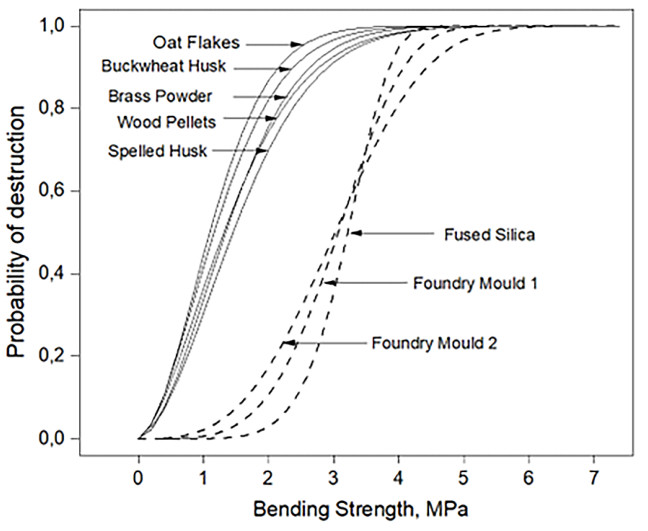
Failure probability of different shell shapes, Figure 5 of original paper (CC BY 4.0)
Shell Requirements and Experimental Design
Nano bainite steel can be used for thinning 0 parts, but hot cracking easily occurs in thin wall parts of investment casting. At the later stage of solidification, dendrites have formed solid skeleton which can transfer tensile stress, but liquid phase between dendrites may not be enough to compensate shrinkage. If the mold shell is too rigid, casting shrinkage is limited and tensile stresses tend to concentrate in the still-weak semisolid region. The shell must have sufficient strength to maintain the cavity size, so the goal was to reduce constraints while retaining the strength required for forming.
The authors compared it with conventional fused silica shells. Table 2 reports directly the mechanical data of five modified shells: oat flakes, wood pellets, buckwheat hulls, spelt hulls and brass micropowder. Each group consists of top layer, 5 back layers and sealing layer. The location of the modified sanding is written as the 3rd backing layer in the experimental section, and the discussion section is written as after the 5th coating. 2 described consistent approach is to modify as sanding concentration is arranged in the layer 1. If the modified material is directly mixed into the slurry, it will be dispersed into multiple layers along with the backing layer coating, and the resulting strength and air permeability may also be different.
Silica sol was used as binder, fused silica as filler and sand as sand for the standard shell. Silica sol with a solid content of 24 wt.% is used as the backing layer, and the filler is about 200 meshes of fused silica, the particle size of sanding is 20 - 50 meshes, and the filler ratio is 60 wt.%. The groups share these basic conditions and the focus of comparison is on the modified layer itself. the shell were dried at 21. degree. C. and 45% relative humidity, dewax with 8 bar steam for a period of 20 minutes, and then calcined at 500. degree. C. for 4 hours to remove residual wax. After these conditions are selected, rectangular cross section test strips and spherical shell samples are prepared, respectively, the former for bending resistance test and the latter for permeability and porosity measurement.
Botanical materials and metal micropowders have adopted two different ideas. During the casting process of nano-bainitic steel, the highest shell temperature is about 1100 ℃. the organic material is lost on ignition dure heating and pore may be left in that original particle locations. The average particle size of brass powder is 63 μ m and liquidus temperature is 1027 ℃. The influence of brass powder on strength after melting at high temperature stage of shell mold is investigated. Both mechanisms may weaken the shell, but the loss of ignition creates voids and the particles fuse into a continuous phase, resulting in completely different venting conditions.
Bending test was used to evaluate the load-bearing capacity of the shell. Young's modulus and Weibull's modulus were also investigated. The discreteness of stiffness and failure data was observed respectively. The authors also compare the effects of different modified materials by CT section, porosity and permeability tests. Even if the total porosity of the two samples is similar, the pore size, shape and connectivity may be different, so it is not possible to judge whether the shell can be degassed and yielded only by porosity.
After baking, the specimen was subjected to a 3-point bending test with a support span of 25 mm and a loading head speed of 1 mm/min. Formula (2) in the paper gives the bending strength σ=3FL/(2bh²) of rectangular section, where F is the load, L is the span, and b and h are the width and thickness of the test strip respectively. The paper also calculates the strain from the deflection, and then calculates the Young's modulus from the relationship between the stress and the strain. The high temperature tensile test is selected at 1050 ℃. The average flexural strength of the same material indicates the typical load level, while the discrete degree of specimen failure is evaluated by Weibull fitting.
The thermal analysis results show the changes of the modified materials before and after pouring. The ignition temperatures of several organic materials are about 598 - 709 ° C, which is lower than the highest temperature of the shell recorded in the study. Brass micropowder transforms into liquid phase after approaching its liquidus. Figures 2 and 3 of the original paper compare thermal analysis curves with casting process temperatures to illustrate why both types of materials may weaken the shell. The results of thermal analysis were compared with those of cross section observation.
In FIG. 4, the relative pore volume of the unmodified fused silica shell is about 4.8%, that of the organic material group is about 10.6% to 22.4%, and that of the brass micropowder group is about 5.0%. The porosity of metal group is close to that of reference group, but the subsequent bending strength is obviously different. This comparison shows that the overall porosity can be used as one of the screening indexes when designing the modified layer, and the strength should be judged according to the shape of matrix, particles and the position of modified layer in the shell thickness direction.
the pac characteristics of that particle were also measured. In Table 1, the angles of repose for oatmeal and wood particles are 45.2° and 48.3°, respectively, reflecting slower free flow. In addition, the ratio of true particle density to bulk density was used to evaluate the sand spreading method. The ratio of spelt hull to buckwheat hull was about 8 and 6 respectively, higher than oatmeal and wood grain. The particle transport index here is mainly used for selecting the shell equipment, and the permeability of the shell for exhaust gas belongs to two different measurements.
Modification Effects and Trial-Casting Validation
Compared to the baseline shell, the abstract of the paper reports that the bending strength of the modified shell is reduced by about 58%-62%. 1.2 - 1.5 MPa discussed in this paper is the bending strength range of the shell samples studied. the failure probability curve are shown in Fig. 5 for a comparison of that different shells, and in Fig. 6 the permeability is given separately. The two tests should be considered together, because reducing the strength does not in itself guarantee that the gases generated in the casting will escape.
In Table 2, the fused-silica control has a flexural strength of 3.48 ± 0.61 MPa. Oatmeal group was 1.32 ± 0.28 MPa, wood granule group was 1.46 ± 0.31 MPa, buckwheat shell group was 1.45 ± 0.39 MPa, spelt wheat shell group was 1.51 ± 0.76 MPa, brass micropowder group was 1.22 ± 0.28 MPa. When compared group-by-group, the decrease was about 65% for the brass micropowder group and about 57% for the spelt wheat hull group, so the range given in the abstract is suitable as a magnitude summary. Young's modulus of control group was 4.41 GPa, oatmeal group was 2.43 GPa, brass micropowder group was 0.42 GPa. At the same time, the stiffness of the shell also changes with the modified material, and the amplitude is not consistent.
The Weibull modulus of the control group was approximately 6.68 and the modified groups were approximately 1.60 - 1.79. According to the statistical treatment adopted in this paper, lower modulus corresponds to greater strength dispersion. When adjusting the average strength, it is also necessary to observe the differences between the individual parts, especially whether the shell can be stably loaded from handling to pouring. The vertical and horizontal coordinates of Figure 5 correspond to the fitting relationship, and the stress level and curve slope selected need to be considered at the same time when reading the figure.
At room temperature, differences in air permeability can be seen between organic material groups. At 1050 ℃, the difference between multi-group and control group was close to measurement error. The exception reported in the paper was the Spelt wheat hull group, which had about 21% higher high temperature permeability and a porosity of 22.4%. For brass micropowder group, the air permeability measurement could not be obtained because of air flow obstruction. The authors explain that molten brass may form a continuous barrier layer, which makes this group unsuitable for direct use in production, even if it reduces the strength of the mold.
The voxel size of cross-section CT was 50 μm. The authors observed the modified layer by means of pore morphology and anisotropy. It is pointed out that the matrix remains between the organic particles and microcracks in the matrix may provide a path for gases. The isolated large pores after particle burning may not penetrate the shell. It can be understood that increasing pore volume and improving high temperature exhaust are not necessarily synchronized. For practical thin-walled parts, poor venting is of particular concern because gas drag may increase the risk of local undercasting of the cavity.
The author also compares the influence of modified materials on sanding process. Lower density wheat hulls and buckwheat hulls may require fluidized bed sanding equipment, and oatmeal and wood pellets are closer to conventional sanding materials in terms of spreading characteristics. Figure 7 shows an exemplary piece used to inspect for hot cracks. Test castings show that the strength range used in the study is capable of obtaining castings with no observed hot cracking under the conditions of the nano-bainitic steel and test pieces. When used in other alloys or parts, it should also be verified in combination with actual solidification shrinkage, shell size stability and exhaust conditions.
The thin-walled section of the demonstration piece transitions from about 1.0 mm on one side to about 2.0 mm on the other side, with a cross-sectional area of about 60 mm². This shape is used to limit shrinkage and make it easy to form tensile stress for observation when solidifying. The author chose oatmeal scheme to make 3 shells and cast nano-bainitic steel, 12 samples were obtained. Visual inspection did not reveal hot cracks or undercasting. The oatmeal scheme with consideration of bending strength, air permeability and manufacturing feasibility was selected for trial casting, and the bending data of other modified groups were obtained from shell sample testing. This distinction determines which results have been verified by actual casting and which are still evidence of the material screening stage.
Jacek Nawrocki、Kamil Dychtoń、Mirosław Tupaj、Piotr Garbień,Advances in Science and Technology Research Journal,20(8),451–461。 Original Paper · PDF · CC BY 4.0
Related News

Xinghua Liangze Metal Products Co., Ltd. specializes in precision investment casting.
Contact us
- Service line
- 0523-83788318
- Telephone
- 1875249989713814494169
- 2082804352@qq.com
- Address
- Peima Industrial Zone, Dainan Town, Xinghua, Jiangsu, China
Copyright © 2024 Xinghua City Liangze Metal Products Co., Ltd
鲁公网安备37010402441776号粤ICP备2026145563号-2