
Heat Transfer in 3D-Printed Sand Molds: Six Aggregate–Binder Systems
Published:
2024-07-29
Six silica, Cerabeads and chromite binder systems are tested by calorimetry and molten-aluminum immersion. Mass-specific heat, volumetric storage and contact degradation are evaluated separately.
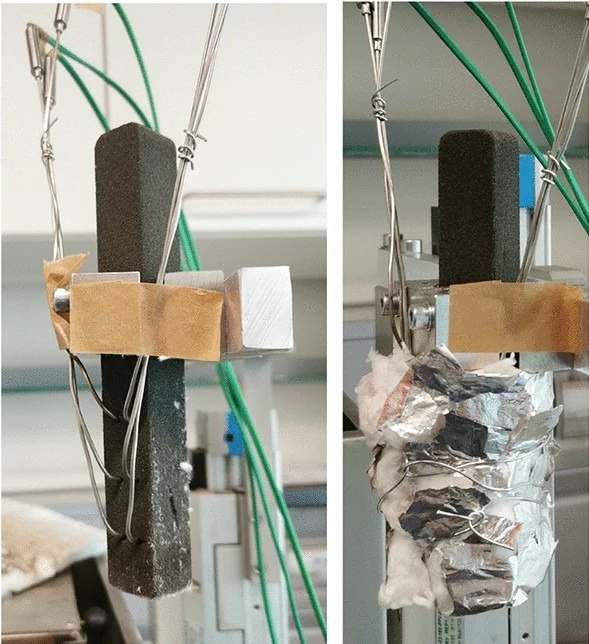
Figure 3 . Two thermocouple triplets and an insulated test bar.
Six Printed Materials and Two Thermophysical Tests
Printability and heat removal during pouring are different issues. Complex cavities, cores and feeders still depend on material thermal properties for local solidification. This light-alloy study compares six silica/Cerabeads/chromite–binder systems, separately measuring specific heat and diffusivity, then calculating conductivity using actual specimen density to support local mold-material selection.
Table 1 lists silica–furan SiFu, density 1.28 g/cm³ and binder 1.2%; silica–phenol SiPh, 1.32 and 2.2–2.4%; silica–inorganic SiIO, 1.25 and 2.8–3.4%; Cerabeads–furan CBFu, 1.48 and 1.1%; Cerabeads–phenol CBPh, 1.43 and 1.9%; chromite–phenol ChroPh, 2.31 and 3.2%. AFS fineness is 97 for silica, 65 for Cerabeads and 71 for chromite.
Aggregate | Binder | Code | Densityg/cm³ | Binder contentwt.% |
|---|---|---|---|---|
Silica (AFS97) | Furan | SiFu | 1.28 | 1.2 |
Silica (AFS97) | Phenol | SiPh | 1.32 | 2.2-2.4 |
Silica (AFS97) | Inorganic | SiIO | 1.25 | 2.8-3.4 |
Cerabeads (AFS65) | Furan | CBFu | 1.48 | 1.1 |
Cerabeads (AFS65) | Phenol | CBPh | 1.43 | 1.9 |
Chromite (AFS71) | Phenol | ChroPh | 2.31 | 3.2 |
These are printed bulk densities, not mineral crystal densities. Layer thickness is 0.28–0.30 mm. Furan uses acid-premixed sand and selective furfuryl-alcohol deposition with cold curing. Phenol uses untreated sand and infrared heating. Waterglass-based inorganic binders cure by dehydration, using infrared or microwave treatment. Aggregates, bridges and voids all change, so aggregate name alone cannot determine complete heat-transfer behavior.
Specific heat uses a NETZSCH STA 449 F3 Jupiter combining TGA and DSC. Although rated for 20–1400 °C, measurements stop at 750 °C for aluminum casting and heat at 10 K/min. After evacuation, argon and a sapphire reference are used. Samples cut from printed bars preserve bridges/packing and flat crucible contact. Each system is measured at least three times, avoiding substitution of crushed/recompacted material for the printed body.
Argon favors pyrolysis over combustion, so measured behavior differs from full oxidation in air. Rough particles and uneven contacts affect crucible heat transfer and scatter. Atmosphere, loading and material state must therefore accompany the curves; they are not context-free constants.
A modified COGAS device measures diffusivity. Bars of 22.4 × 22.4 mm section, corresponding to common bending specimens, dip 5 mm into A356/EN-AC AlSi7Mg0.3 melt along the print direction. Melt temperature stays 745±5 °C; bars are uncoated. Oxide is removed before dipping but immediately reforms, retaining realistic wetting/contact rather than ideal perfect contact.
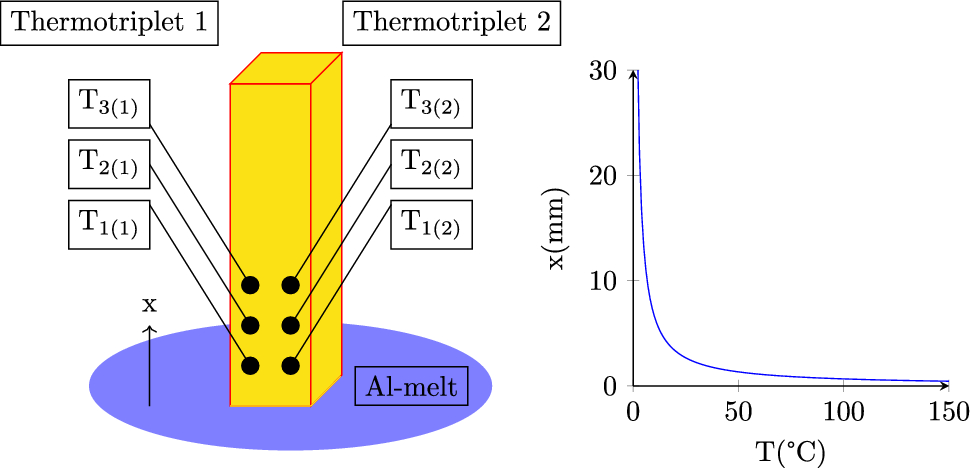
Each bar has two triplets, vertical spacing 10 mm, lowest thermocouple 20 mm from the heated face. Type-K/Quantum X records at 100 Hz. Sides are insulated to expose mainly the base. Three bars per system are stored 24 h at 20 °C and 10% relative humidity, giving six triplets per system. Testing stops when lower thermocouples reach 150 °C.
Original Eq. (5) divides temporal temperature change by a three-point spatial second difference: α = (ΔT₃/Δt)/[(T₃−2T₂+T₁)/(Δx)²]. A 4 s smoothing window prevents noisy derivatives producing negative/unphysical values. Diffusivity describes thermal-response propagation; conductivity additionally requires density and mass-specific heat through λ = α·ρ·cₚ. The two parameters are not interchangeable.
Temperature Intervals, Density and Binder-Bridge Degradation
Specific heat is compared at 100, 300, 500 and 700 °C. Mass-based values are relatively close, with small binder proportions. Density changes volumetric heat storage substantially: low heat per kilogram can coexist with high heat per mold volume. Mass-based selection and selection for available mold space can therefore differ.
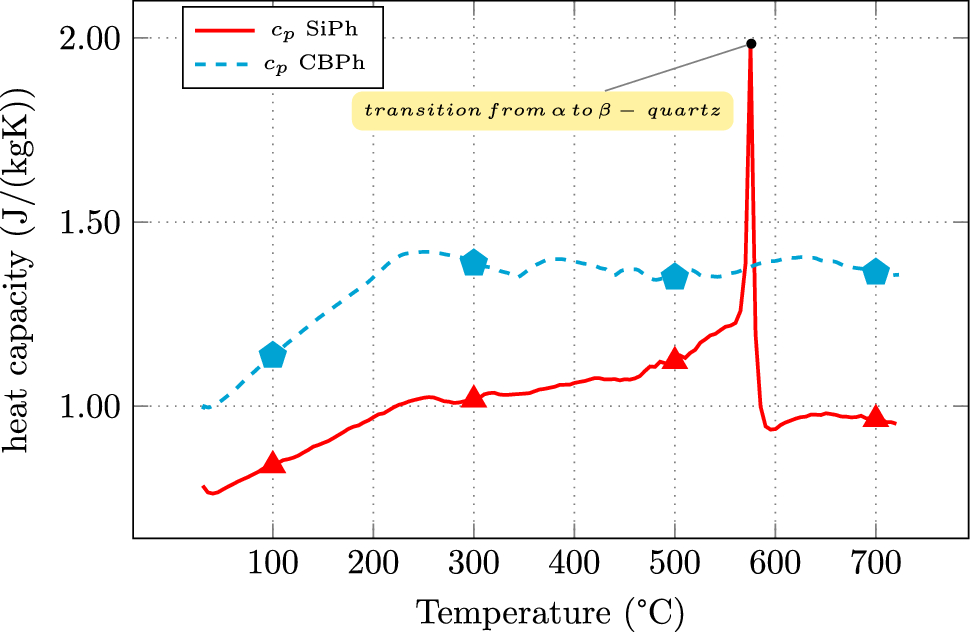
Silica transforms from α- to β-quartz near 573 °C with about 0.8% expansion, reversible on cooling. This affects heat-capacity curves and cannot simply be smoothed into a constant. Cerabeads does not show the same transition. Higher-temperature transformations are discussed, but the measurements target aluminum casting up to 750 °C, not complete properties at all temperatures.
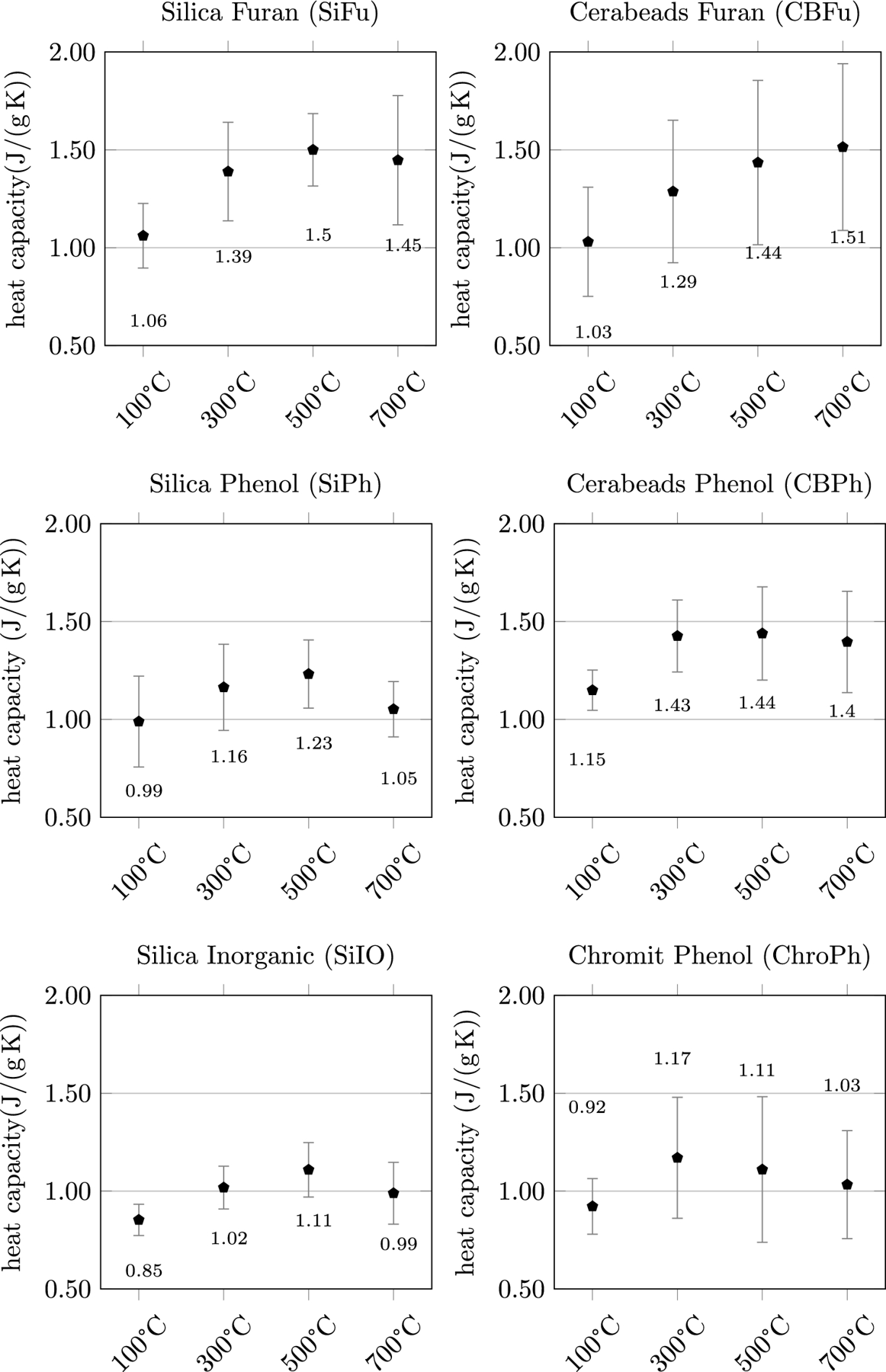
Furan-bound silica and, over some intervals, furan-bound Cerabeads show higher heat absorption; inorganic silica is lower. Possible contributors include organic-binder pyrolysis, continued reactions in incompletely cured regions and water release, while waterglass mainly dehydrates. Measured trends and proposed mechanisms are distinct; one thermal curve cannot uniquely separate every reaction contribution.
Chromite has relatively low mass-specific heat but printed density 2.31 g/cm³, markedly higher than the others, giving high volumetric capacity. A given wall thickness/volume matters for casting heat removal, not just handbook heat per kilogram. This is not a recommendation to use chromite everywhere: cost, function and local solidification targets still matter.
Three-point diffusivity scatters over 35–150 °C, especially the initial 35–50 °C interval. Central portions of the measurements reduce outlier effects. Results are reported separately for 35–150 and 100–150 °C. The latter has steadier temperature histories and lower scatter. These intervals describe reliability differences, not duplicate plots.
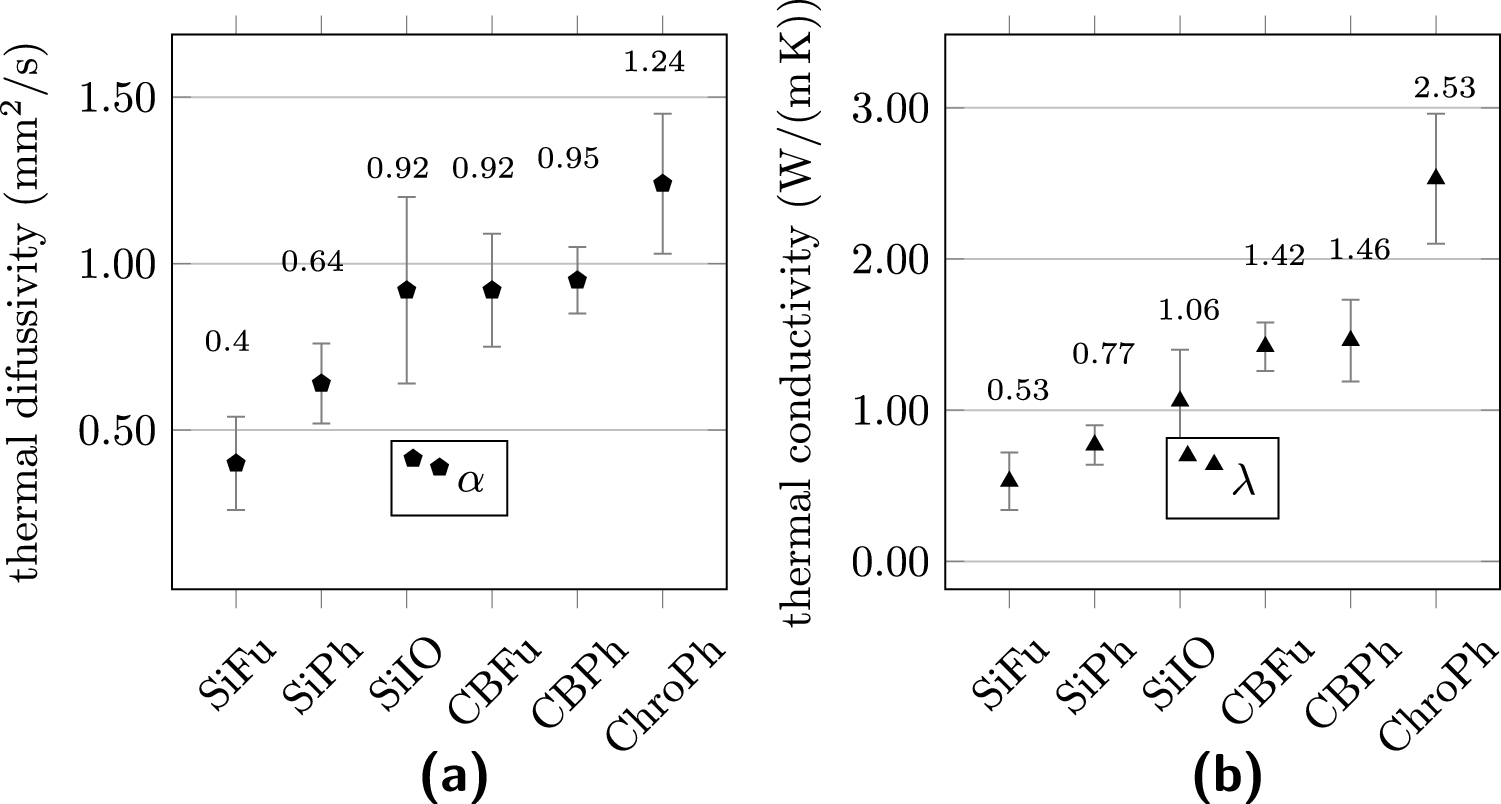
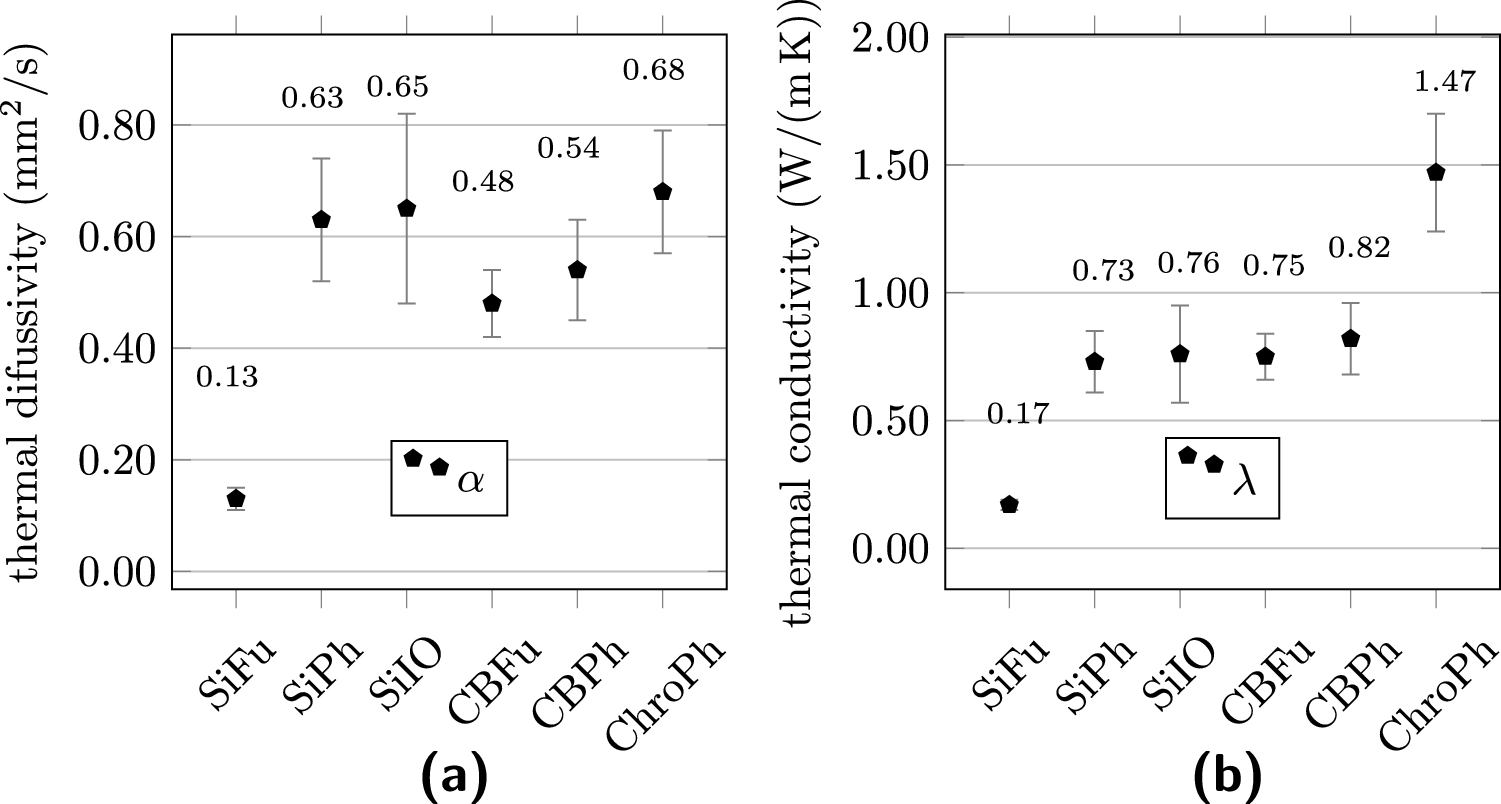
Conductivity uses each bar’s measured density and DSC specific heat at 100 °C, neglecting tiny drilled-hole volume loss. Average diffusivity/conductivity generally rise from silica to Cerabeads to chromite, with error bars still showing uncertainty. These are system/interval-specific results, not a fixed conductivity guaranteed by aggregate name.
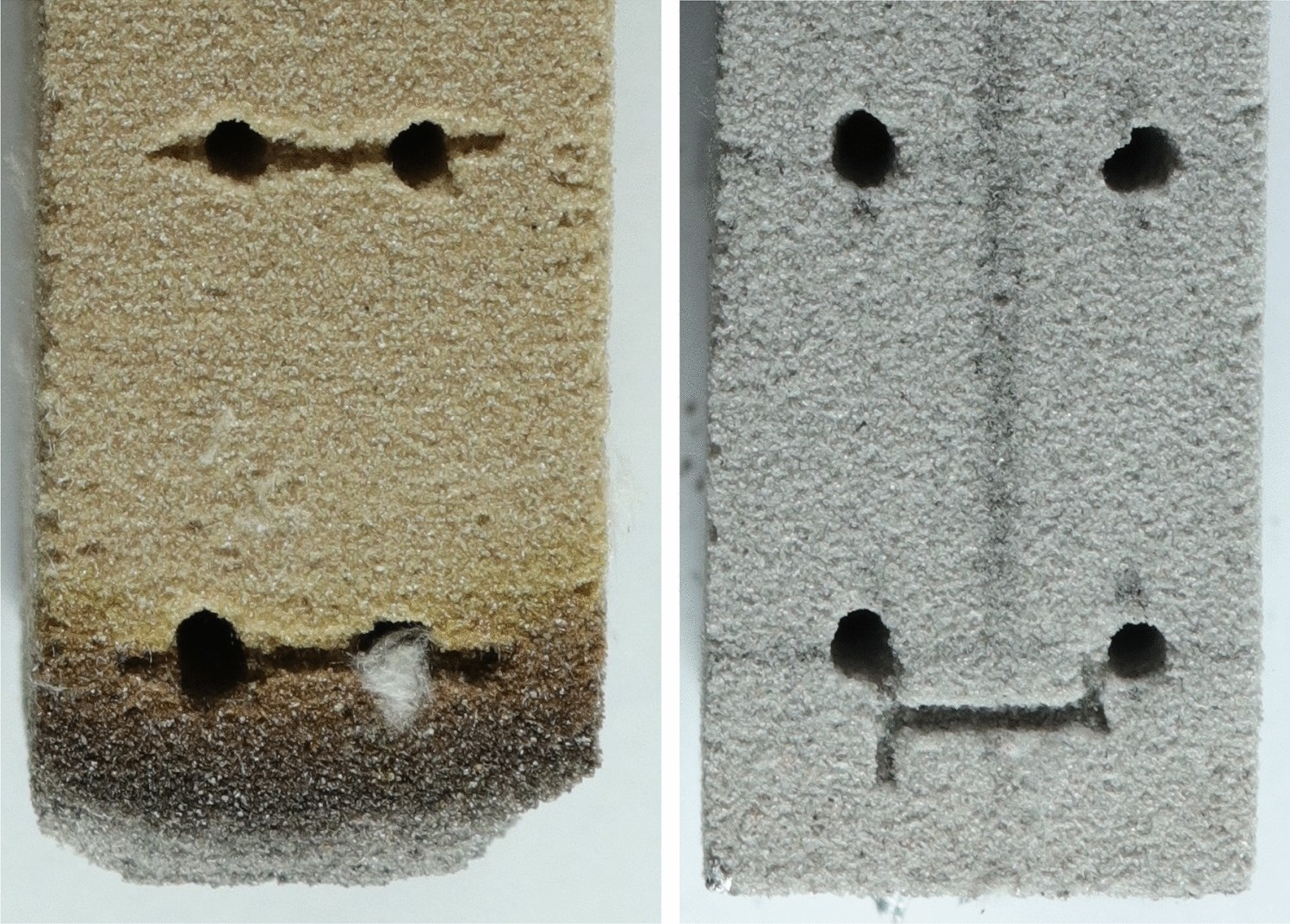
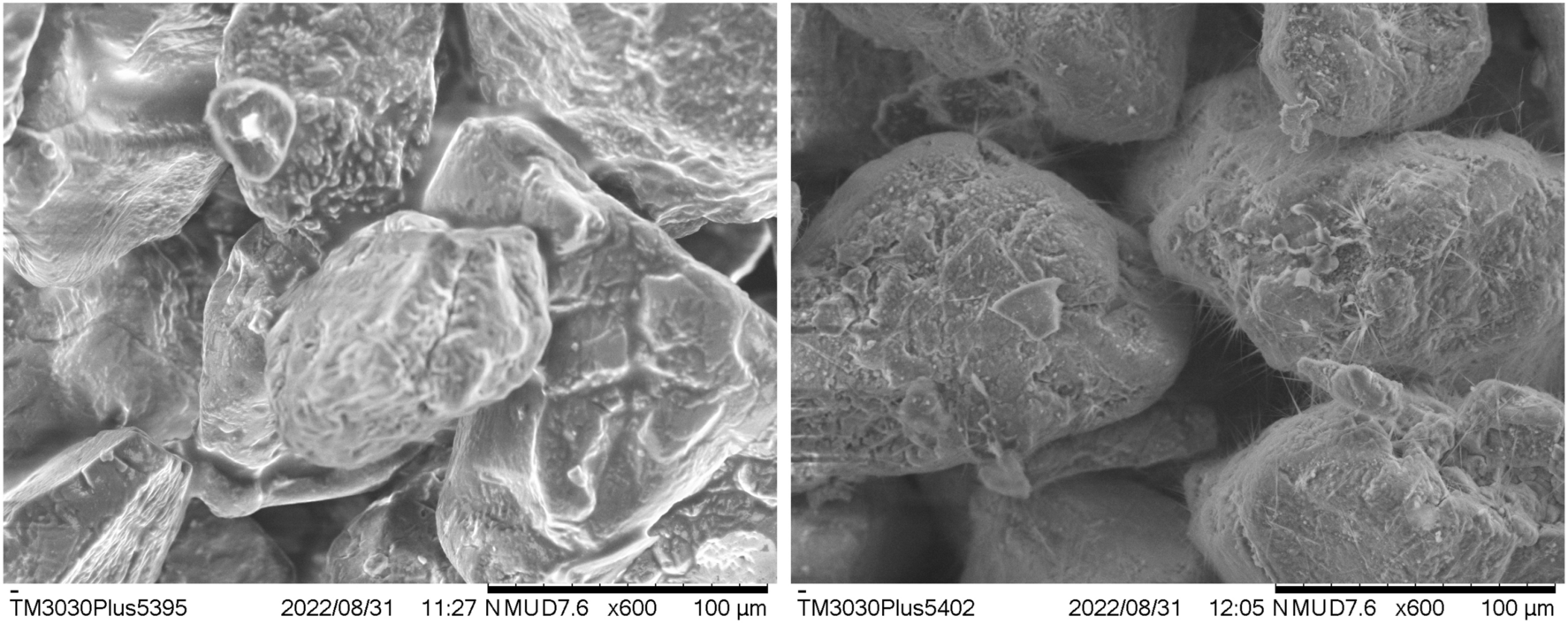
Interface changes add another explanation. Continuous heating degrades organic bridges and rounds bar edges, while inorganic edges stay intact. Figure 8 compares the ends; Fig. 9 shows phenolic bridges and glassy waterglass threads. These change wetting/contact area and contribute to measured transfer, beyond intrinsic grain conductivity.
The furnace continuously maintains melt temperature, unlike cooling metal in a casting. Poor thermocouple contact can instead measure slower heating of bore air; damaged/expanded side insulation admits lateral heat. Contact, insulation and numerical smoothing therefore accompany interpretation. A diffusivity value should not be transferred into simulation without its method context.
Diffusivity describes propagation, specific heat energy per mass, and volumetric capacity also includes density. A fast temperature response does not imply maximum stored heat per mold volume. The study measures heat capacity separately, derives diffusivity from temperature records, then conductivity using both and density. Mixing specific heat from one sand with density from another packing state no longer represents the tested body.
Molding sand is a heterogeneous grain/bridge composite with roughly half its volume occupied by air. Effective parameters include grain contacts, bridges and pore transport, not just single-grain properties. Local contacts and roughness vary, so preserving the printed structure and avoiding bridge crushing during sectioning/loading is important for realistic simulation inputs.
The six systems do not vary only binder at fixed content: aggregate, fineness, density and formulation also change. They compare practical systems; isolating resin chemistry would require further controls. Small binder mass does not make bridges/reactions irrelevant, as observed end degradation demonstrates.
The relatively affordable measurement route links heat capacity, density, diffusivity and interface evolution, informing local mold/core selection and simulation. Improved thermocouple contact/shielding, more repeats and reaction studies are needed to reduce scatter. Its value is comparable measured evidence, not one universally optimal sand system for all light-alloy castings.
Source: Kleinhans, Robert, Pintore, Manuel, Erhard, Patricia, Renz, Ralph, Tesfu, Johanna. Thermal Properties of 3D-Printed Molds for Light Metal Casting. 2024-07-29. DOI: 10.1007/s40962-024-01411-8. Adapted from the open-access paper; original figure/table numbers retained. CC BY 4.0.Original paper · Direct PDF · CC BY 4.0 ·
Related News

Xinghua Liangze Metal Products Co., Ltd. specializes in precision investment casting.
Contact us
- Service line
- 0523-83788318
- Telephone
- 1875249989713814494169
- 2082804352@qq.com
- Address
- Peima Industrial Zone, Dainan Town, Xinghua, Jiangsu, China
Copyright © 2024 Xinghua City Liangze Metal Products Co., Ltd
鲁公网安备37010402441776号粤ICP备2026145563号-2